RFID and NFC: why pit two complementary technologies against each other?
Building security today relies on wireless identification, but technical jargon often creates confusion for decision-makers. When evaluating a corporate badge system, the acronyms RFID and NFC are constantly mixed up or wrongly used interchangeably. Yet these two technologies address distinctly different security constraints and operational use cases. What criteria genuinely set an RFID reader apart from an NFC reader? How do you make the right choice for each infrastructure, based on frequency, read distance and the level of control required? A closer look at a complementary pair of protocols, their applications and the devices involved.
RFID and NFC: complementary, yet frequently confused
In the world of access control, treating NFC as the same thing as conventional RFID is a common technical error. A simple networking analogy helps clarify the distinction: having a Wi-Fi network means you have wireless communication, but it doesn’t guarantee you have internet access. Conversely, delivering an internet connection doesn’t presuppose the use of Wi-Fi. RFID and NFC follow exactly this same logic of inclusion: NFC is one technology within the vast set of RFID technologies. Understanding this hierarchy is essential to choosing the right reader and the right access cards.
RFID: the umbrella method using radio waves
RFID (Radio-Frequency Identification) is the generic term covering all wireless identification technologies that use electromagnetic fields. An RFID architecture pairs a reader with a badge, a card or a tag fitted with a chip. It serves to identify or track people and objects through the exchange of data between these devices. Depending on the radio frequency used, several families can be distinguished: low frequency (LF, 125 kHz), high frequency (HF, 13.56 MHz) and ultra-high frequency (UHF, 860–960 MHz). Some professional UHF RFID systems allow long-range reads, notably via active tags or beacons fitted with a battery. These UHF tags are commonly used for logistics, inventory or vehicle access over long distances, whereas other HF tags are limited to close proximity.
The diversity of these frequencies explains why RFID covers such a broad spectrum of applications: from tracking objects in a warehouse to identifying people at control points. Each card or tag is tied to a specific frequency, which the reader must be able to decode in order to grant access.
NFC: the specialised evolution based on induction
NFC (Near Field Communication) is in fact a highly specific subcategory of RFID, operating exclusively on the HF 13.56 MHz frequency. Unlike conventional long-range UHF radio communications, NFC works only at very short range (a few centimetres) using magnetic induction: the reader emits energy that is captured by the badge or card to trigger the data exchange. The native integration of NFC into smartphones changed everything: it enables flexible two-way communication, turning the phone into a highly secure virtual badge.
This technology does more than read an identifier: it allows an encrypted dialogue between the two devices, strengthening the security of every transaction. It is this two-way communication, absent from read-only RFID, that fundamentally sets NFC apart. NFC applications extend well beyond access control alone: contactless payment, transport, data sharing between compatible devices.
BLE is ideal for environments requiring mobility – parking lots, logistics centers, and smart buildings. Its low power consumption also makes it well-suited for battery-operated equipment.
The LiNEGUARD answer
A common misconception: assuming an RFID reader is necessarily basic and poorly secured (limited to reading a simple serial number), or assuming an NFC reader offers universal compatibility with no configuration required.
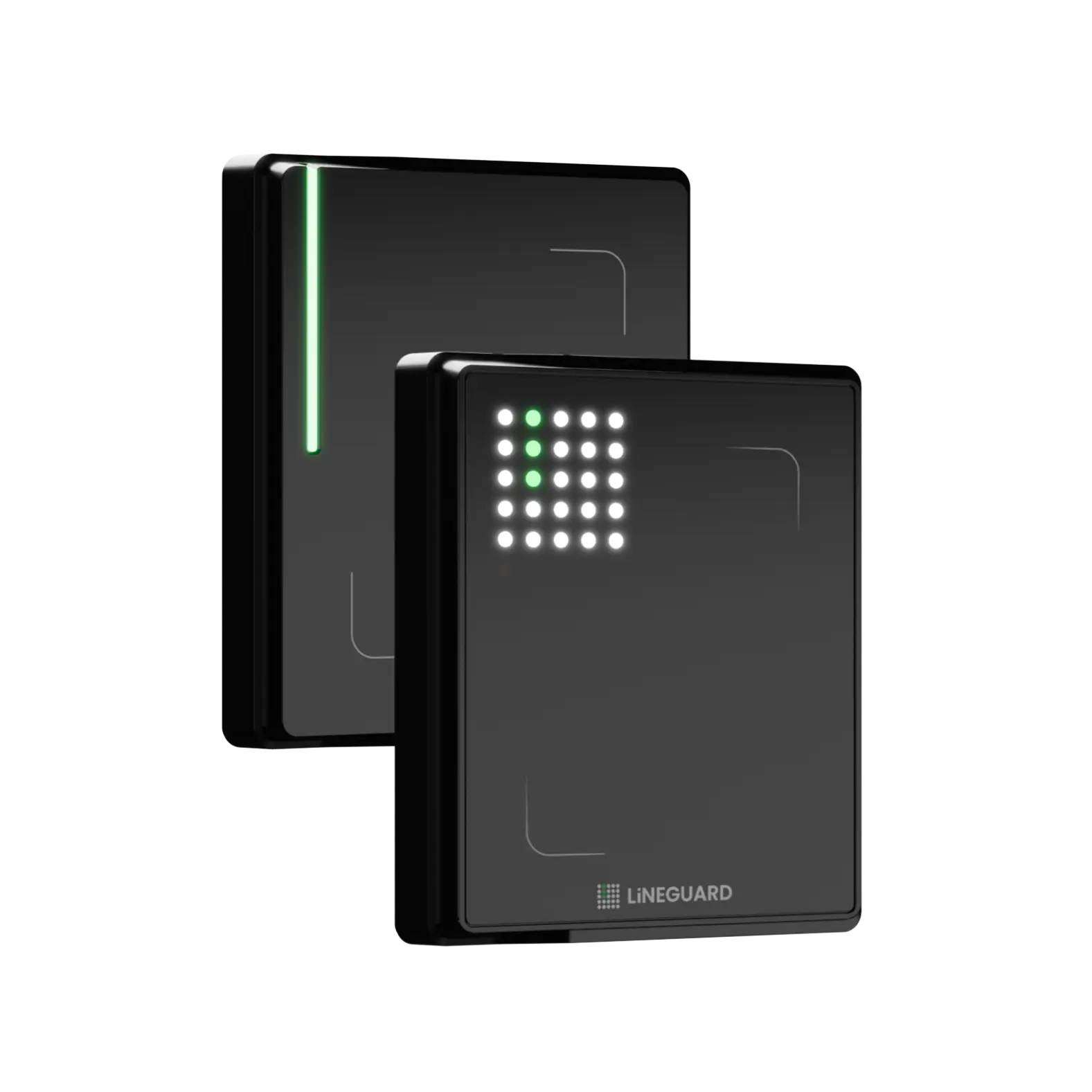
At LiNEGUARD, this subtlety is removed thanks to universal reading solutions. The readers are able to decrypt physical RFID badges and cards (such as DESFire technology at 13.56 MHz). At the same time, they seamlessly accept NFC virtual badges from Android smartphones or iPhones. There’s no longer any need to choose: LiNEGUARD unifies the best of both worlds within a single infrastructure, with reliable identification whatever credential is presented. This high level of security relies on encrypted communication between the reader and each card or smartphone.
The concrete benefits
Uncompromising security against hacking: LiNEGUARD readers do more than read a public identifier. They leverage state-of-the-art encryption on physical badges and smartphones to neutralise any copy immediately. Fitted with a “Secure Element”, a dedicated vault for security keys, they block any extraction of credentials and guarantee full protection against spoofing. This technology ensures the integrity of the data exchanged and maximum security at every identification.
A smooth transition to the virtual badge: employees can keep their current badges and cards, while newcomers are given the option of opening doors directly with their smartphone using NFC. This technology makes gradual adoption easier without having to replace all existing devices.
Zero compatibility headaches: where some readers on the market reject third-party protocols, the LiNEGUARD ecosystem centralises compatibility to instantly recognise the various chip types (MIFARE® technology – Classic, Ultralight, Plus, DESFire® – & NFC smartphones). A single reading technology covers all these applications, whatever the card or tag used.
Frequently asked questions
What is the fundamental difference between RFID and NFC?
RFID is the umbrella technology for identification via radio waves, covering several frequencies (LF, HF, UHF) and a wide range of applications. NFC is a specific branch of RFID that works only at very short range (less than 4 centimetres) on HF 13.56 MHz, and enables advanced interactions, notably two-way communication with smartphones and other devices.
Is an RFID reader less secure than an NFC reader?
No, that’s a misconception. Security depends on the badge, the card and the reader’s configuration. An RFID system using DESFire® cards (MIFARE® technology) with a reader configured to current security standards offers maximum protection for sensitive sites. Data encryption technology matters more than the acronym used.
Can any smartphone be used with a corporate NFC reader?
Not automatically. Although most smartphones are NFC-enabled, the company’s reader and the dedicated mobile application (such as LiNEGUARD’s own, LiNEGUARD Access) must be compatible and correctly configured in order to mutually authenticate, secure the data communication and trigger the door release. This mutual identification ensures no unauthorised device can get through the access control.
Which RFID frequency should you choose for your access control?
For identifying people, high frequency (HF 13.56 MHz), which NFC is also based on, remains the standard: it offers the best balance between security, short read distance and card compatibility. Long-range UHF is better reserved for vehicle or logistics applications, where tags need to be read from several metres away. The right reader therefore depends on your use cases and the devices already in place.