Radio Frequency Identification: Optimizing Access Control
Radio frequency identification, or RFID, structures security and traceability for modern enterprises. Whether managing access badges, securing IT fleets, tracking assets, or automating people flow, this technology has become essential due to its ability to process information and data remotely and contactless. From warehouse inventory management to corporate access control, its applications cover a very wide spectrum. However, faced with the diversity of frequencies, products, and chip types available, defining the infrastructure adapted to the requirements of a professional site remains a challenge.
What are the key mechanisms of RFID? How do you select the essential components and solutions to guarantee high-performance access control and reliable data management?
RFID in business: understanding the technology to apply it effectively
RFID (Radio Frequency Identification) makes it possible to identify an object or a person via radio waves, without requiring a direct line of sight. Unlike optical technologies such as barcodes, the information on a badge, tag, or sensor can be read through walls, clothing, or bags. This technical feature offers full operational flexibility and explains the success of RFID in fields as varied as logistics, manufacturing, and access control. A complete system relies on the interaction of three essential components: the badge (the chip and its antenna), the badge reader, and the access control unit.
Each of these components plays a precise role in the identification chain. The badge stores credentials on its chip and communicates via its antenna by transmitting the signal, while the reader queries the assembly to validate an identification or report information back to the central system. The quality of the antenna directly determines the read range and the technology’s reliability in demanding environments. These three building blocks form the foundation of RFID solutions deployed in corporate settings, regardless of the target application.
Passive or active chips: a matter of range
The choice of components directly depends on the detection range required by the infrastructure and the type of products to be identified:
- Passive chip: lacking a battery, it draws its energy from the magnetic field emitted by the reader via its antenna. Economical and durable, it has no lifespan limit and equips the vast majority of corporate access badges and physical tags. Its range extends from a few centimeters to several meters depending on the frequency, making it the preferred solution for individual identification of people and access control.
- Active chip: embedding an autonomous power source (battery), it continuously emits its signal. Capable of reaching a range of 100 meters, it is reserved for tracking high-value assets, vehicles, or real-time location in large industrial and logistics spaces. These active tags are at the heart of mobile inventory management and advanced traceability solutions, where long-range reading is essential.
The right balance between passive and active chips therefore depends on the applications: access control and document management on one side, asset tracking and logistics on the other. A company can combine both within a single system, depending on the nature of the products and information to be processed.
Frequency bands: from access control to logistics
RFID technology is divided into three major frequency families, each tied to specific uses and applications:
- Low Frequency (125 kHz): Considered today as an obsolete technology due to its lack of encryption mechanisms, LF nevertheless remains widely used in legacy installations and existing equipment fleets.
- High Frequency (13.56 MHz): The current standard for access control, HF includes NFC (Near Field Communication). Its ultra-close reading range (under 4 cm) and its ability to handle complex encryption make it the ideal solution for modern access control and the digitization of credentials on smartphones. These frequencies prioritize security and identification precision over range, making them perfectly suited for corporate access solutions.
- Ultra-High Frequency (UHF): Enabling bulk reading at long distance and high speed, UHF dominates stock management, inventory, and logistics flows. Thanks to this technology, hundreds of tags can be read simultaneously as a pallet passes through a gantry, radically transforming product management and asset tracking in warehouses. The data collected feeds the information system in real time, offering complete visibility across the supply chain.
Choosing the right frequency band comes down to identifying the exact need: secure proximity identification for people, or bulk long-range reading for logistics and inventory management.
The LiNEGUARD answer for deploying a safe and efficient RFID ecosystem
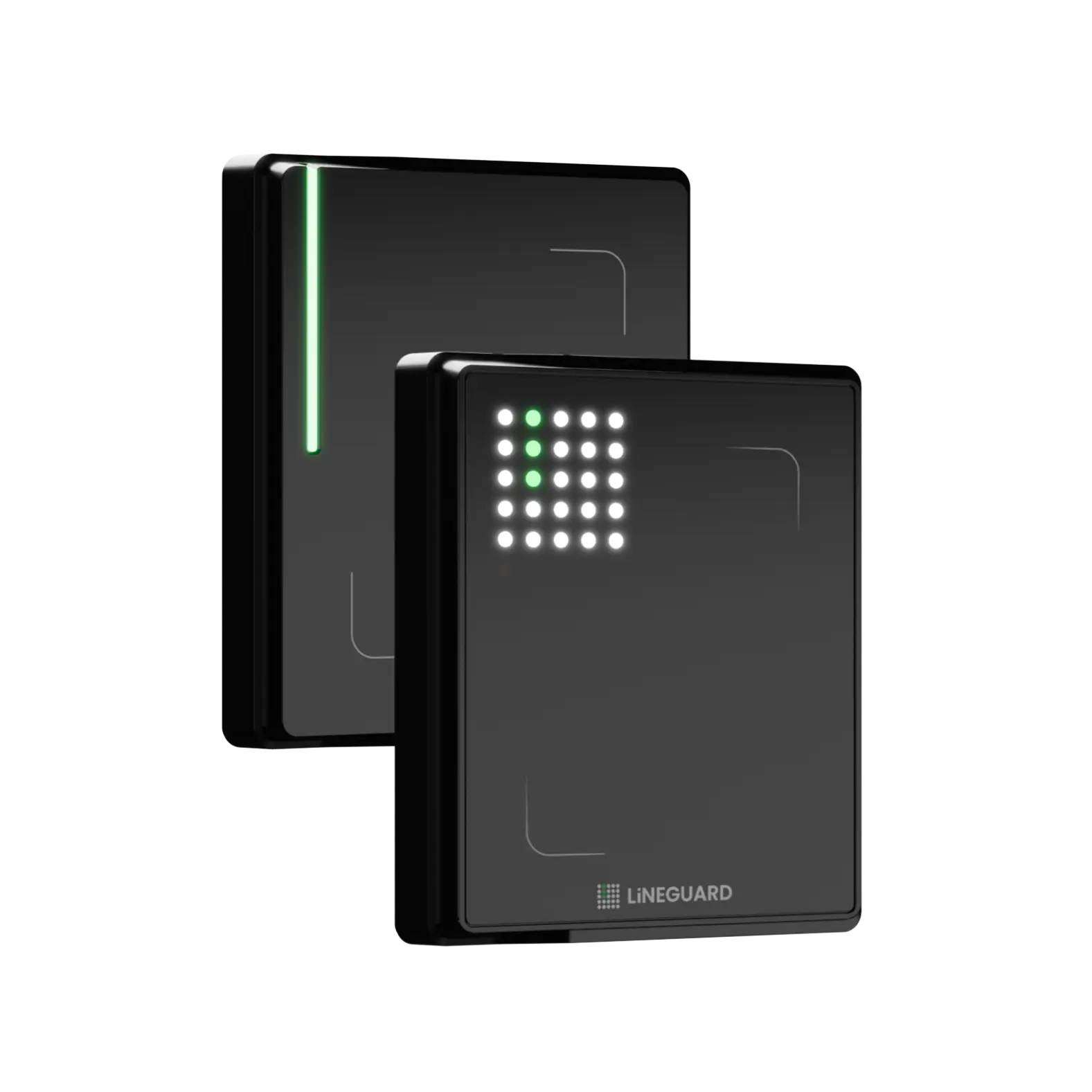
Deploying an RFID ecosystem in a professional environment often exposes sites to two risks: data interception on poorly protected chips or hardware incompatibility between different badge and tag fleets. LiNEGUARD addresses these critical requirements by offering universal, highly secure access control readers. By combining hardware robustness with modern software protocols, LiNEGUARD guarantees a seamless transition to mobile credentials on smartphones, without compromising physical building security.
This approach allows every company to build a perfectly consistent access control architecture, centered around two complementary tools:
- LiNEGUARD Studio: dedicated to technical reader configuration, this tool allows you to define accepted badge technologies (MIFARE Plus, MIFARE DESFire EV1/EV2/EV3, etc.) and integrate the security keys required for encryption.
- The central controller software: dedicated to operational administration, it centralizes user profile creation, badge association, and granular access rights management.
Whether protecting sensitive premises, IT assets, or logistics areas, LiNEGUARD readers ensure reliable identification and centralized access data management.
The tangible benefits of RFID in business with LiNEGUARD
An RFID project for your business?
Deploying RFID across an enterprise requires combining technical performance with software security. From inventory management and identity verification to asset tracking and logistics traceability, this technology provides tailored solutions for every operational need. To modernize your access infrastructure with a reliable ecosystem capable of processing your data securely, explore the LiNEGUARD product catalog or request a personalized project assessment through the contact page.
HTML
Frequently Asked Questions (FAQ)
How to secure an RFID badge against remote hacking?
Protection relies on the choice of cryptographic protocol. Standard reading of the public identifier (UID) must be avoided in favor of secure chips with encrypted rewritable memory, paired with readers capable of performing strong mutual authentication. This technology ensures that the data and information contained within the badge cannot be copied, regardless of the targeted system.
Is RFID affected by metal or liquid environments?
Yes, radio waves can be absorbed by liquids or reflected by metal, which impacts the antenna and reading quality. In access control as in logistics, this constraint is handled by using specialized insulated tags (for metal surfaces) and calibrated industrial-grade readers to maintain consistent reading performance across all products.
What is the difference between UHF RFID and NFC for a company?
UHF is designed for bulk reading at long range (inventory, logistics, asset and stock tracking). NFC is optimized for near-field individual identification (under 4 cm), making it the ideal technology to turn a smartphone into a secure access badge. The choice between these two solutions therefore depends on the application: logistics management on one hand, secure access control on the other.