NFC or Bluetooth: the question inevitably arises whenever you design or upgrade an access control system. These two wireless technologies coexist in smartphones, access badges, and readers, but they operate on different principles. Range, data rate, power consumption, security, and data transmission: each criterion clearly distinguishes them.
What Is NFC?
NFC (Near Field Communication) is a very short-range wireless communication technology based on electromagnetic induction. As a subset of the RFID standard, it operates at a frequency of 13.56 MHz and enables data transmission between two devices separated by a maximum of 4 to 10 centimeters.
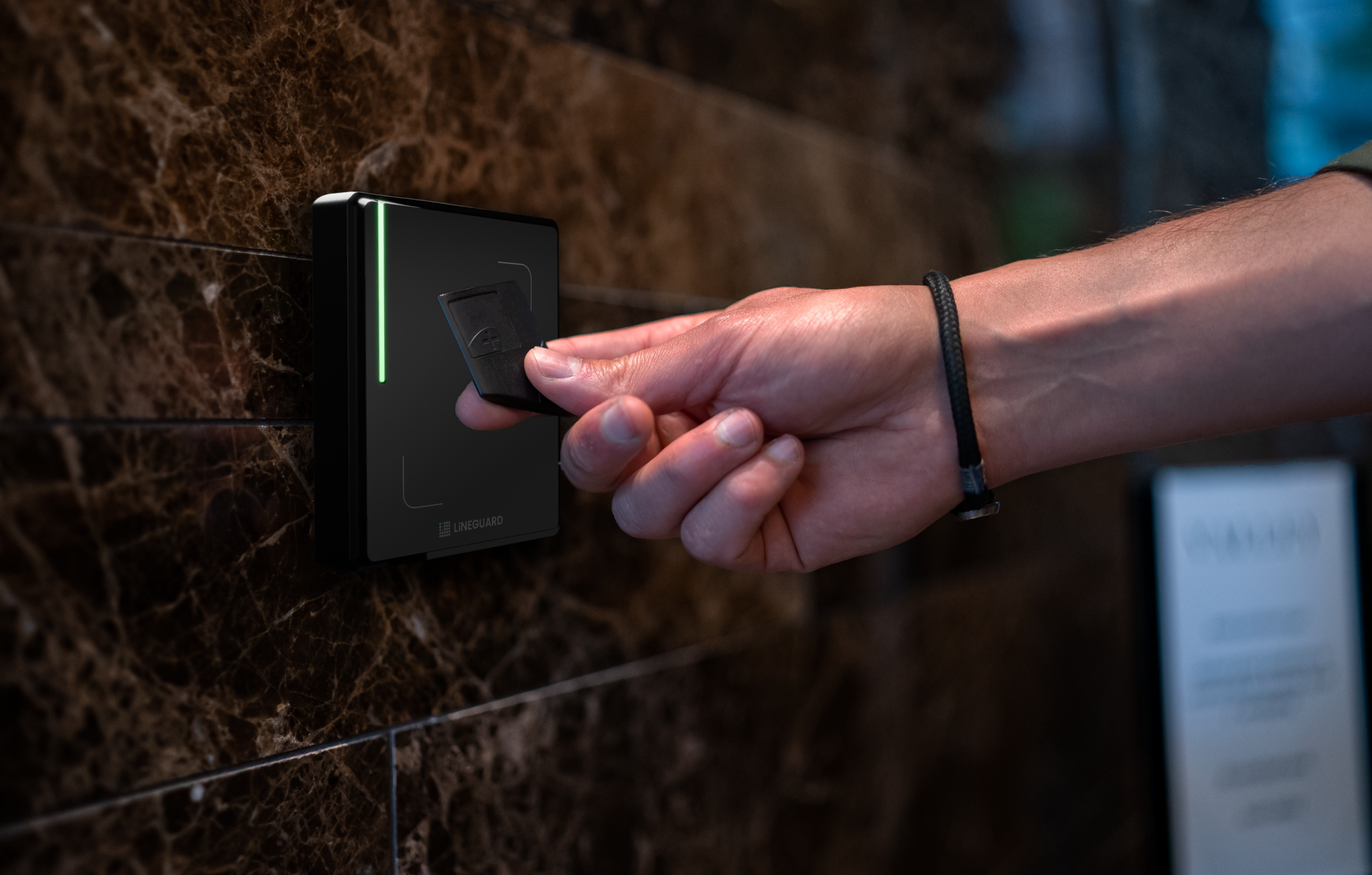
This proximity requirement is not a limitation—it is the core of its security value. The user must physically bring their badge or smartphone close to the reader to trigger the opening. There is no ambiguity regarding intent, and the risk of interception is virtually zero.
Key Technical Specifications:
- Frequency: 13.56 MHz (ISO/IEC 14443 standard—same basis as high-frequency RFID)
- Effective range: 4 to 10 cm
- Transmission rate: up to 424 kbit/s
- Activation time: less than 100 ms—a speed imperceptible to the user
- Low power consumption: the passive tag requires no external power source
- Compatibility: Apple Pay, Google Pay, MIFARE, HID, and DESFire cards
In B2B access control, NFC has established itself as the standard. Its speed and low power consumption make it the benchmark for secure access in business, hospitality, healthcare, and industry.
What is Bluetooth Low Energy?
Bluetooth Low Energy (BLE) is a variant of the Bluetooth protocol optimized for minimal power consumption. It operates in the 2.4 GHz band, similar to Wi-Fi, and enables communication over distances of up to 100 meters in an unobstructed environment.
Unlike NFC or RFID, BLE establishes a continuous connection between devices. This enables advanced use cases: automatic detection of a smartphone as it approaches, hands-free unlocking, and real-time updates to access rights without physical contact.
Key Technical Specifications:
- Frequency: 2.4 GHz (ISM band, shared with Wi-Fi)
- Effective range: 10 to 100 meters, depending on the environment
- Data rate: 125 kbit/s to 2 Mbit/s (BLE 5.x)
- Extremely low power consumption, hence the “Low Energy” designation
- Connection speed: established automatically as soon as the device is within range
- Compatibility: all modern smartphones (iOS 5+ / Android 4.3+)
BLE is particularly well-suited for environments requiring mobility: parking lots, logistics warehouses, and smart buildings. Its low power consumption also makes it ideal for battery-powered devices.
NFC vs Bluetooth: Comparison Chart
| Criterion | NFC / HF RFID | Bluetooth Low Energy |
|---|---|---|
| Range | 4 to 10 cm | 10 to 100 meters |
| Frequency | 13.56 MHz | 2.4 GHz |
| Data Rate | Up to 424 kbit/s | Up to 2 Mbit/s |
| Power Consumption | Low (passive tag without battery) | Very low (optimized) |
| Activation speed | < 100 ms | ~6 ms (BLE 5) |
| Security | Very high (proximity required) | High (128-bit AES encryption) |
| Access mode | In-person (badge/phone) | Hands-free / remote |
| Smartphone compatibility | iOS 11+ / Android 4.0+ | iOS 5+ / Android 4.3+ |
What are the use cases for each technology?
When Should You Choose NFC?
NFC—and, more broadly, high-frequency RFID—is essential in any context where security is a priority:
- Access to sensitive areas: server rooms, archives, restricted zones
- High-traffic, multi-user environments: hotels, coworking spaces, residential buildings
- Industrial sites requiring strict access tracking
- Compatibility with existing RFID badges (MIFARE, DESFire, HID)
When should you choose BLE?
BLE is the preferred choice for applications requiring seamless operation or remote management via smartphone:
- Parking lots and vehicle access: automatic opening upon approach
- Logistics warehouses: moving through zones without handling the phone
- Smart buildings: continuous connection with home automation systems
- Dynamic access rights management: remote revocation in real time
NFC vs Bluetooth: Which Technology Is More Secure?
Both technologies encrypt their communications using AES 128-bit encryption, but their security models differ fundamentally.
NFC derives its robustness from its physical constraint inherited from RFID: intercepting a communication requires being within 10 cm of the target, which mechanically limits attack vectors. Modern DESFire EV2/EV3-type badges add mutual authentication with a unique code per transaction, rendering cloning useless even in the event of interception.
BLE secures its communications using robust pairing protocols (Secure Simple Pairing). Its extended range is its primary risk factor. Well-designed implementations incorporate effective countermeasures against relay attacks, particularly on networks in close proximity to Wi-Fi.
In summary: NFC offers intrinsic security that is ideal for high-security access. When properly implemented, BLE provides a very satisfactory level of protection for most professional applications.
LINEGUARD Readers: Native NFC and Bluetooth Integration
Rather than forcing a choice, LINEGUARD natively integrates both technologies into each of its badge readers. A single device manages all access modes: physical RFID badge, NFC smartphone, or hands-free BLE smartphone.
Switching from NFC mode to hybrid NFC + BLE mode takes just a few clicks in LINEGUARD Studio, without the need for hardware replacement or on-site intervention. Access rights can be updated remotely via a simple internet connection.
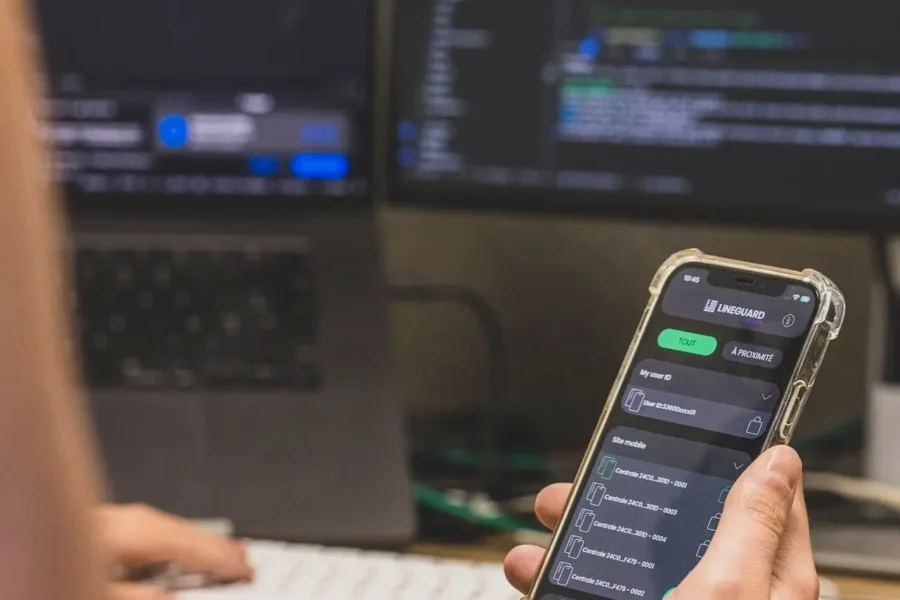
The LiNEGUARD Access app allows disabling either technology.
This approach offers three concrete advantages:
- Flexibility at no extra cost: a single reader model covers all current and future use cases
- Software scalability: the switch to hybrid mode is done via a software update, without hardware migration
- Security through complementarity: NFC handles proximity authentication, while BLE handles remote transmission; the two protocols reinforce each other
This technological synergy reflects LiNEGUARD’s core expertise in system interoperability and scalable installations.
FAQs
What is the main difference between NFC and Bluetooth?
The range and the method of interaction. NFC requires physical proximity of less than 10 cm. BLE has a range of up to 100 meters and allows for automatic connection via a smartphone. This difference determines whether access requires a deliberate action or not.
Is NFC an RFID technology?
Yes. NFC is a subset of RFID, limited to the 13.56 MHz frequency and a range of less than 10 cm. RFID covers a broader spectrum of frequencies and distances. NFC adds bidirectional communication, which is absent in traditional RFID.
Is Bluetooth more secure than NFC?
No, both technologies encrypt their communications using AES 128-bit encryption. NFC has a physical advantage due to its ultra-short range. BLE compensates with robust authentication protocols. The choice should be based on the specific use case.
Are LINEGUARD readers compatible with Apple and Android?
Yes. They support NFC via Apple (iOS 11+) and Google (Android 4.0+), as well as BLE on all iOS 5+ and Android 4.3+ smartphones. No dedicated app is required for NFC access.